Protein for combat athletes: what to eat, how much and what it costs
By Javier Feliubadaló Circle Academy Barcelona
In this article
The essentials
If you train jiu-jitsu or MMA several times a week, you need more protein than someone who is sedentary. But you do not need to live on shakes: ordinary supermarket food can easily cover your needs. In this article I explain how, with real numbers and prices.
We compared 26 foods, 4 types of protein powder and essential amino acid powders using official food composition tables, product labels, October 2026 prices and the latest studies. Here is what you need to know:
- How much: between 1.4 and 2.0 g per kilogram of body weight a day; 1.6 g/kg is a useful target. If you weigh 75 kg, that is about 120 g.
- How to spread it out: 3 to 5 servings of 20 to 40 g. Having one near training is convenient, but your daily total matters most.
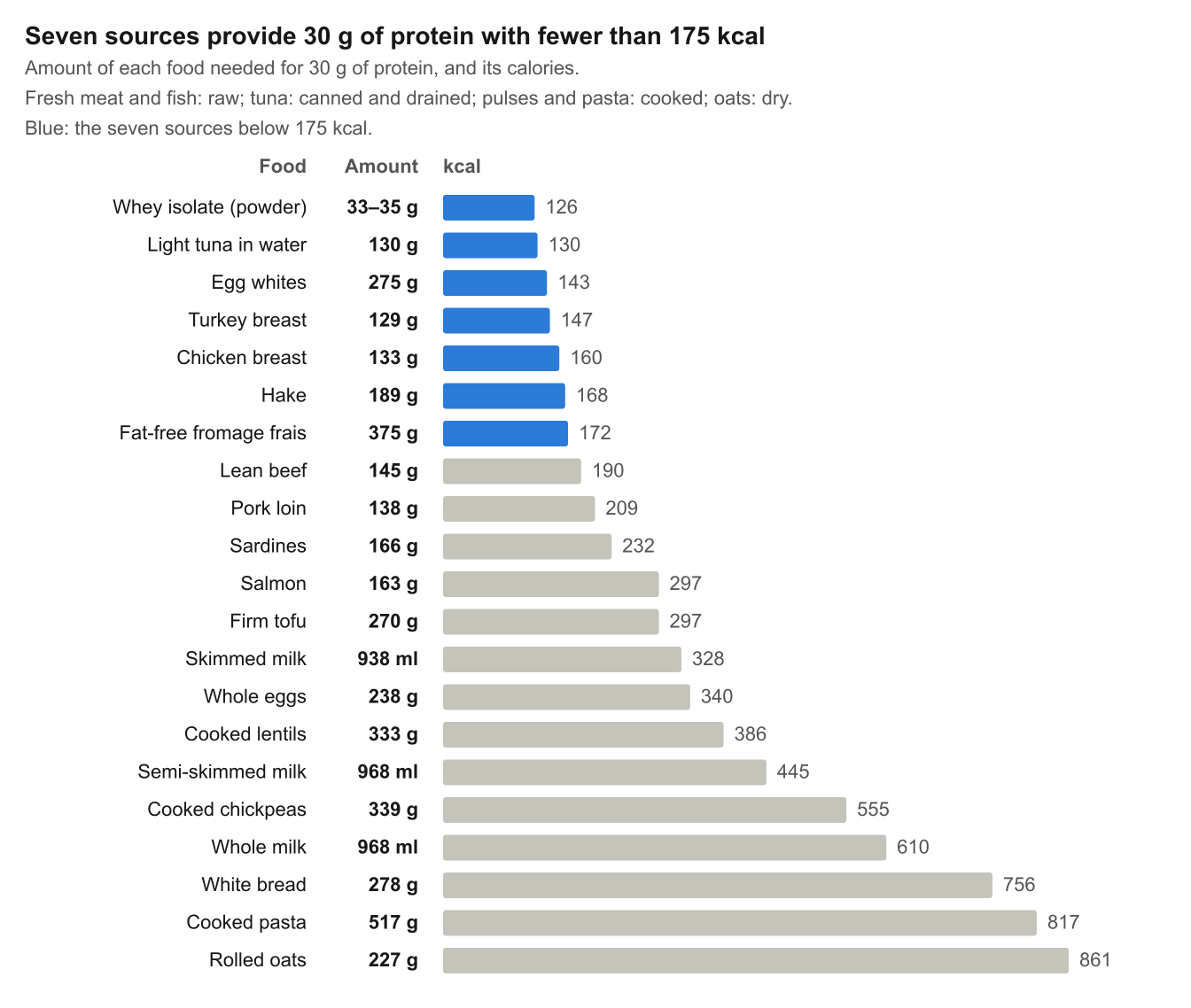
- The lowest-calorie options: tuna in water, egg whites, turkey or chicken breast, hake and fat-free fromage frais provide 30 g of protein with fewer than 175 kcal.
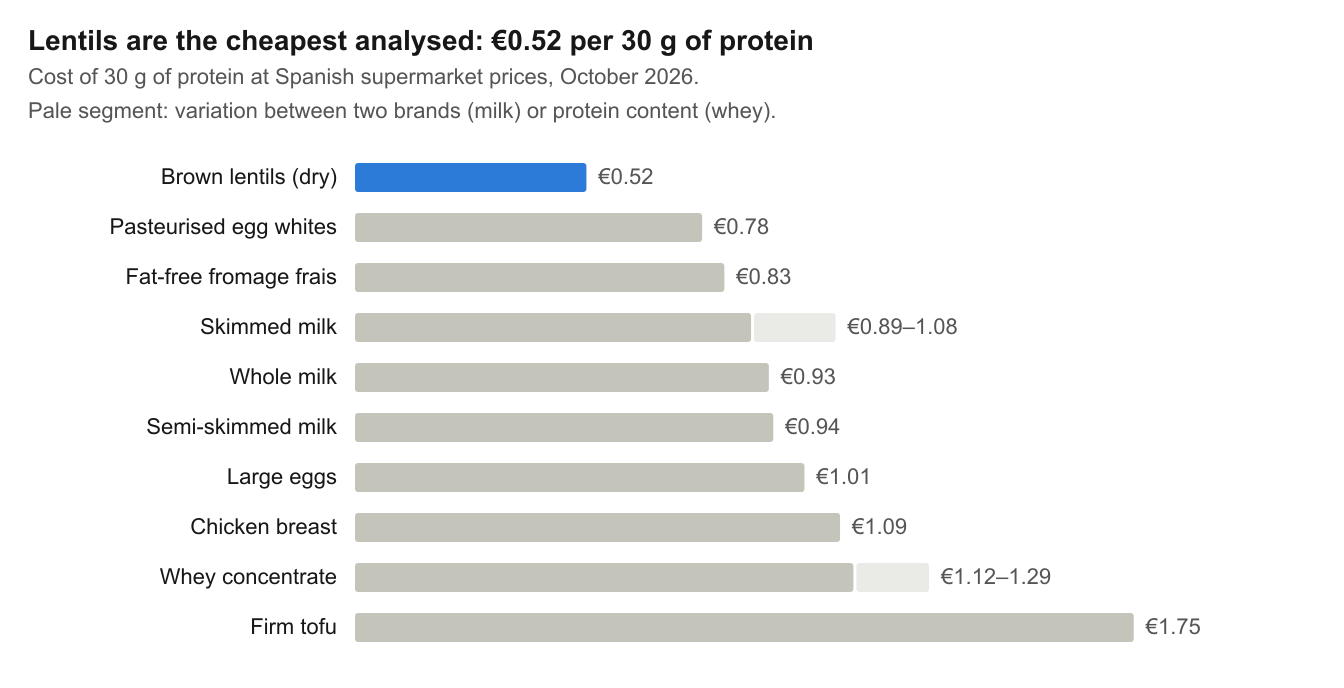
- The cheapest option we analysed: lentils, at about €0.52 per 30 g of protein.
- Plant or animal protein? Once you meet your total needs, the differences are small, and trials comparing soy and milk have found no significant differences.
- Shakes: optional. They are convenient, not magical, and they do not save money compared with lentils, eggs, milk or fromage frais.
- If you compete: gradually losing fat is different from making weight by dehydrating yourself. For fat loss, keep protein high without cutting the carbohydrates you need for training.
The underlying idea is to meet your protein needs, rather than eat as much as possible, while getting enough energy to train, recover and stay healthy.
This article is intended for healthy adults. If you have kidney disease, diabetes or another medical condition, or are planning a weight cut, a healthcare professional should set your individual targets.
How much protein do you need?
The EFSA reference intake for the general adult population is 0.83 g per kilogram of body weight a day. Strength training and combat sports increase your needs: exercise increases muscle protein turnover, and a higher intake supports adaptation.
A meta-analysis of 49 trials found that consuming more protein during strength training added an average of 0.30 kg of fat-free mass. Benefits stopped increasing at around 1.6 g/kg a day, although the confidence interval extends to 2.2 g/kg. This is a population average, not a precise threshold for you.
The International Society of Sports Nutrition (ISSN) recommends between 1.4 and 2.0 g/kg a day for most people who exercise. At 1.6 g/kg, the numbers are:
| Your weight | Daily protein (1.6 g/kg) |
|---|---|
| 60 kg | 96 g |
| 75 kg | 120 g |
| 90 kg | 144 g |
Spread it throughout the day
The ISSN recommends servings of about 0.25 g/kg, or 20 to 40 g, every 3 or 4 hours. If you weigh 75 kg, that works out at four meals containing 25 to 35 g. Eating protein in the hours around training is practical, but there is no need to rush for a shake if your meals before and after already contain it.
There is no fixed limit per meal: in a 2023 trial, 100 g of protein at once produced a larger and longer anabolic response than 25 g. Even so, spreading it out is the most practical way to reach your total without enormous meals.
If you are over 65
The PROT-AGE expert group recommends at least 1.0 to 1.2 g/kg a day for healthy older people, and 1.2 to 1.5 g/kg for those with an acute or chronic illness. It also recommends that everyone in this age group do both strength and aerobic exercise, because protein and exercise together are the best combination for maintaining muscle function.
Losing fat is different from making weight
Combat sports often mix up two different things. One is gradually losing fat over several weeks. The other is dropping weight in the final days, mainly by losing water, to enter your weight category.
Gradual fat loss
In 2025, the ISSN published a position stand specifically on combat sports. For these phases it proposes prioritising protein, with a minimum of 1.2 to 2.0 g/kg a day (1.6 to 2.2 in its practical summary). At the same time, it recommends not going below 3 to 4 g of carbohydrate per kilogram a day, because carbohydrates sustain training.
As a guide, it proposes losing between 0.5 and 1 kg a week, but the pace must be adjusted to the individual: 1 kg is almost 2% of the body weight of someone weighing 55 kg, and 1% for someone weighing 100 kg. Starting well above your category, or with only a few weeks to go, forces you to move faster and take greater risks.
If you are trained and already lean, you may need more protein: 2.3 to 3.1 g per kilogram of fat-free mass, meaning your weight excluding fat (ISSN, 2017). At 75 kg and 15% body fat, that is 147 to 198 g a day. Increase it without cutting carbohydrates, or you will run out of fuel for training.
Making weight
Dropping weight through dehydration in the final days carries risks, and the margin depends on the time between the weigh-in and the match. In jiu-jitsu competitions under IBJJF rules, you are weighed immediately before your first match, wearing your gi in gi divisions, so there is no time to recover; other organisers may operate differently. In professional MMA, weigh-ins are usually the day before, which leaves more time but does not remove the risk.
| Situation | Priority |
|---|---|
| Normal training week | Get enough energy, meet your daily protein needs and adjust carbohydrates to your training volume |
| Preparation with fat loss | A moderate deficit and a pace suited to your body weight, with high protein and sufficient carbohydrates |
| Weigh-in immediately before competing (IBJJF jiu-jitsu) | Reach your weight comfortably in advance, because there is no time to recover |
| Weigh-in the day before (professional MMA) | There is more recovery time, but losing weight through dehydration still carries risks |
| Competition day | Nothing new: only foods and drinks you have already tried in training |
This article does not provide instructions for dehydration, such as using saunas, restricting water or manipulating salt. If undertaken, it must be planned and supervised by a professional who understands your sport and its rules. We discuss planning the days before competition in Tournament week.
Calories and euros: the cost of each 30 g of protein
A serving of 30 g of protein is a useful reference for each meal. The first chart shows how much of each food you need to obtain it and how many calories it provides; the second shows the cost.
View the data in a table
| Food | Amount | kcal |
|---|---|---|
| Whey isolate (powder) | 33–35 g | 126 |
| Light tuna in water | 130 g | 130 |
| Egg whites | 275 g | 143 |
| Turkey breast | 129 g | 147 |
| Chicken breast | 133 g | 160 |
| Hake | 189 g | 168 |
| Fat-free fromage frais | 375 g | 172 |
| Lean beef | 145 g | 190 |
| Pork loin | 138 g | 209 |
| Sardines | 166 g | 232 |
| Salmon | 163 g | 297 |
| Firm tofu | 270 g | 297 |
| Skimmed milk | 938 ml | 328 |
| Whole eggs | 238 g | 340 |
| Cooked lentils | 333 g | 386 |
| Semi-skimmed milk | 968 ml | 445 |
| Cooked chickpeas | 339 g | 555 |
| Whole milk | 968 ml | 610 |
| White bread | 278 g | 756 |
| Cooked pasta | 517 g | 817 |
| Rolled oats | 227 g | 861 |
Data: USDA FoodData Central, Moreiras food composition tables (MAPA) and product labels, compiled in the October 2026 technical report · 21 sources: 20 foods and whey isolate
For a rough idea, 30 g of protein is about 4 large eggs, almost a litre of milk, a 270 g pack of the tofu we checked, or about 120 g of dry lentils.
Lean meat, white fish, egg whites, tuna and fromage frais provide protein with little else: useful when you are losing fat. Pulses, bread, pasta and oats bring plenty of carbohydrates with their protein, providing fuel for training. Those extra calories only become an issue when you are in a deficit.
In milk, the fat content changes the calories, not the protein: choose the type that suits your goal.
Remember: these figures measure how much energy comes with the protein, not whether one food is better. Pulses provide fibre and minerals, and salmon provides omega-3 fats.
View the data in a table
| Food | Cost per 30 g of protein |
|---|---|
| Brown lentils (dry) | €0.52 |
| Pasteurised egg whites | €0.78 |
| Fat-free fromage frais | €0.83 |
| Skimmed milk | €0.89–1.08 |
| Whole milk | €0.93 |
| Semi-skimmed milk | €0.94 |
| Large eggs | €1.01 |
| Chicken breast | €1.09 |
| Whey concentrate | €1.12–1.29 |
| Firm tofu | €1.75 |
Prices checked from 12 to 15 October 2026 in Spanish supermarkets and on a whey protein price comparison website · one product per food, two for skimmed milk
These are prices for a particular product on a particular date, so treat them as a rough guide. Lentils are measured dry: 1 kg yields about 2.7 kg when cooked.
Whey concentrate does not save money compared with milk, egg whites, fromage frais or lentils. It is, however, cheaper than tofu and costs almost the same as chicken breast.
Quality: amino acids, leucine and why combining foods helps
The foods we analysed contain all nine essential amino acids, but not all proteins do: collagen, and the gelatine made from it, lack tryptophan (Paul et al., 2019). That is why collagen powder is not a complete protein on its own, although its amino acids do contribute within a varied diet.
Among sources that contain all nine, the proportions of each amino acid and their digestibility vary. The FAO measures both using a score called DIAAS.
Meat, fish, eggs and dairy score highly, with tofu close behind. Pulses score a little lower, and cereals considerably lower. In practice, eating a little more and combining sources can compensate for this.
Leucine, the muscle-building switch
Leucine is the amino acid that most strongly activates the signal to build muscle, but it needs the other essential amino acids for that building process to continue. The ISSN suggests 0.7 to 3 g per serving as a guide, not a maximum. At 30 g of protein, the sources analysed provide between 1.8 g (pea and quinoa) and 3.3 g (whey), all above the suggested minimum.
It matters more when the serving is small, when the source contains less leucine, as with pea or quinoa, or as you get older. A healthy adult eating about 30 g of protein per meal usually does not need to worry about leucine or supplement it separately.
Pulses and cereals: better together
Pulses are rich in lysine but relatively low in sulphur-containing amino acids; wheat is the other way round. Pasta alone provides only 47% of the lysine in the FAO reference pattern. If half the protein in the dish comes from pasta and half from lentils, that rises to 96%.
You do not need to combine them in the same dish if your daily total is sufficient. Even so, lentils with rice or chickpeas with pasta do it naturally: traditional cooking had already worked it out.
Plant or animal protein? What the evidence says
A 2025 meta-analysis brings together trials comparing plant and animal protein in adults. Muscle mass gains were slightly lower with plant protein, although the difference was small. It was statistically significant in people under 60, but not in older adults, which does not prove that no difference exists in the latter group.
There were no significant differences in strength (14 trials) or physical performance (5), nor when comparing soy with milk (17 trials). That does not prove they are identical in every case, but suggests that any difference is small. With plant proteins other than soy, the difference in muscle mass was greater, although this was based on only 5 trials.
A 12-week trial illustrates this well. Young vegan men using soy and omnivorous men using whey consumed 1.6 g/kg a day and followed the same training programme. They gained similar amounts of muscle and strength.
Pea protein shows why ‘plant-based’ is not a single category. A pea protein emulsion scored 0.60 on DIAAS in minipigs because it was low in sulphur-containing amino acids (Reynaud, 2021). By contrast, a pea isolate reached 1.00 in a study of 15 adults conducted with a manufacturer, in which casein scored 1.45.
Neither result applies to ordinary cooked peas. Evidence on muscle is limited: another 12-week trial, funded by the same manufacturer, found no overall differences between pea, whey and placebo. Pea outperformed placebo only among participants who were weaker at the start, an exploratory finding.
More calories for the same protein, depending on your choices
Plant protein often comes with more carbohydrates and sometimes more fat. We calculated two example days using the same base foods and about 120 g of protein: one mixed and one entirely plant-based, using tofu, pulses and soy drink. The ‘In practice’ section gives the quantities in grams.
In these two examples, the plant-based version provides 10 to 14% more energy, depending on the tofu: 278 kcal more with the product we checked, and about 210 more with a higher-protein tofu. This does not mean a plant-based diet always needs more calories: it depends on the foods and quantities.
If you are gaining weight or training a lot, that difference is not a problem; if you are losing fat, it matters.
If you are vegan or vegetarian
Build your diet around soy (tofu and soy drink) and pulses, and combine them with cereals. If you are vegan, vitamin B12 must come from supplements or fortified foods: it is not optional (US Academy of Nutrition and Dietetics, 2025). If you are vegetarian, check with a professional whether your dairy and egg intake is sufficient.
Conclusion
First, meet your daily target. Then choose according to taste, price, digestion and environmental impact. Per 30 g of protein, beef produces about 15 kg of CO₂ equivalent, 9 times as much as poultry and 25 times as much as tofu, according to global data from Poore and Nemecek (2018).
Shakes and supplements: convenient, not essential
A whey shake is another protein source, with two advantages: it contains little fat or carbohydrate and fits in your bag. Whey isolate supplies 30 g of protein with about 126 kcal, similar to tuna in water.
It is not the cheapest option, though. A reference whey concentrate costs €1.12–1.29 per 30 g of protein: more than lentils, egg whites, fromage frais, milk or eggs, almost the same as chicken breast and less than tofu.
Which type to choose, if you use one
- Concentrate (WPC): the basic option. It contains some lactose.
- Isolate (WPI): purer, with very little lactose; it is often well tolerated with mild lactose intolerance. But it is still milk protein, so it is not suitable if you are allergic to milk.
- Hydrolysate (WPH): absorbed faster, but there is no strong evidence that it produces more muscle over the long term.
- Casein: digested slowly. In studies, taking 30–40 g before bed increased muscle protein synthesis overnight, although this is not essential if you already meet your daily total. Fat-free fromage frais is a reasonable food alternative because its protein is mainly casein.
- Essential amino acid (EAA) powders: there is little evidence that they outperform whey. If you already meet your daily protein needs, you do not need them.
Pay attention to product quality
In 2025, Consumer Reports analysed 23 protein powders and shakes sold in the US. More than two thirds exceeded the organisation’s daily lead limit per serving, a very conservative threshold of its own. Plant-based products contained about 9 times more lead on average than dairy-based ones, although these results cannot simply be applied to products sold in Spain.
If you compete under anti-doping rules, use only products with independent certification, such as Informed Sport or NSF Certified for Sport. These reduce the risk of contamination with prohibited substances but do not eliminate it. We review which supplements have evidence for competition in Energy systems and nutrition for BJJ competition.
A transparency note
This article does not recommend brands and compares shakes and food using the same criteria.
Myths and common questions
‘Greek yoghurt is packed with protein’
It depends on the product. One supermarket ‘Greek-style’ yoghurt we checked contains only 3.9 g of protein and 10.8 g of fat per 100 g. Strained or ‘high-protein’ versions may contain much more, so read the label. The fat-free fromage frais in our comparison contains 8 g.
‘Goat’s milk is easier to tolerate if cow’s milk upsets you’
Not necessarily. It contains 4.5 g of lactose per 100 g, almost the same as cow’s milk. In a study of children allergic to cow’s milk, 92% also reacted to goat’s milk.
If you have a milk allergy, do not use it as a substitute without discussing it with your allergist.
‘Raw eggs are absorbed better’
The opposite is true. In a human study, the body used 91% of the protein from cooked eggs and only 51% from raw eggs. The study used eggs, not egg whites alone, but cooking is the sensible choice and also avoids the risk of salmonella.
‘Turkey deli slices are the same as turkey breast’
No. Deli slices are processed meat, classified by the IARC in Group 1: there is strong evidence that it causes cancer, although that does not mean the risk is the same as smoking. Fresh turkey breast, by contrast, is one of the lowest-calorie meats: 147 kcal per 30 g of protein.
‘Pork loin is white meat’
The IARC considers pork red meat (Group 2A, probably carcinogenic), and cured pork loin is processed meat. Fresh loin is lean and inexpensive, and counts as one of your weekly portions of meat.
‘Skimmed milk raises blood sugar more than whole milk’
There is no practical difference: skimmed milk has a glycaemic index of 37 and whole milk 39, both low (Atkinson, 2008). Skimmed milk contains slightly more lactose, but less than 1 g extra per 250 ml glass, and the glycaemic load per glass is almost identical.
Both produce a relatively large insulin response compared with their small effect on glucose, with no difference between them. Overall, however, intervention trials do not show that milk worsens insulin sensitivity.
Choose milk according to calories: to obtain 30 g of protein, skimmed milk provides 328 kcal, semi-skimmed 445 and whole milk 610.
‘Soy feminises men’
Trials do not support this. In a meta-analysis of 41 studies in men, soy and its isoflavones did not significantly change testosterone or oestrogen. In postmenopausal women, another meta-analysis also found no changes in four markers of oestrogenic effects.
‘Tuna contains too much mercury’
Light tuna is not among the fish with the highest mercury levels, which AESAN identifies as bluefin tuna, swordfish, shark and pike. Even so, alternate tuna with hake, sardines or salmon, which contain little mercury.
If you are pregnant or trying to conceive, recommendations are stricter: discuss them with your midwife or doctor.
In practice: your training week
What to eat and how often
The Spanish Agency for Food Safety and Nutrition recommends these frequencies for adults (AESAN, 2022). They are a useful basis for varying your protein sources:
| Food group | Frequency |
|---|---|
| Pulses | At least 4 servings a week |
| Fish | 3 or more a week, prioritising oily fish |
| Eggs | Up to 4 a week |
| Meat | A maximum of 3 servings a week; preferably poultry and rabbit, with as little processed meat as possible |
| Dairy | Up to 3 servings a day, with no added sugar |
| Nuts | 3 or more servings a week |
Two example days with about 120 g of protein
Both days share the same base foods (oats, banana, walnuts, quinoa, broccoli, apple and olive oil); only the protein sources change. Calorie figures come from the composition records in the technical report.
| Mixed day | Food | Protein | kcal |
|---|---|---|---|
| Breakfast | 250 ml skimmed milk, 60 g rolled oats, 120 g banana and 15 g walnuts | 19.5 g | 520 |
| Lunch | 110 g chicken breast (raw), 180 g cooked quinoa, 300 g boiled broccoli and 20 g olive oil | 39.8 g | 630 |
| Snack | 200 g fat-free fromage frais and 180 g apple | 16.5 g | 186 |
| Dinner | 140 g salmon (raw), 150 g cooked lentils, 250 g boiled broccoli and 15 g olive oil | 45.2 g | 649 |
| Total | 121.0 g | 1,984 |
| Plant-based day | Food | Protein | kcal |
|---|---|---|---|
| Breakfast | 300 ml unsweetened fortified soy drink, 60 g rolled oats, 120 g banana and 15 g walnuts | 20.1 g | 531 |
| Lunch | 200 g firm tofu, 180 g cooked quinoa, 300 g boiled broccoli and 20 g olive oil | 37.3 g | 718 |
| Snack | 80 g cooked chickpeas and 180 g apple | 7.6 g | 225 |
| Dinner | 200 g firm tofu, 300 g cooked lentils, 250 g boiled broccoli and 15 g olive oil | 55.2 g | 788 |
| Total | 120.1 g | 2,262 |
Totals may not match to the last decimal because of rounding. The tofu is the Spanish product we checked, containing 11 g of protein per 100 g. With a tofu containing 17 g per 100 g, a total of 257 g would suffice and the plant-based day would fall to about 2,190 kcal.
These illustrate how to distribute protein; they are not complete meal plans. If you train daily, you probably need more energy: add bread, pasta, rice or fruit according to your expenditure, which will also contribute some protein.
Around training
If you train in the afternoon or evening, eat something containing protein a few hours beforehand and do not arrive hungry. Afterwards, have dinner with 30 to 40 g of protein and some carbohydrates, especially after hard sessions.
If you get home late, use quick options: fromage frais, milk, tuna in water, eggs or, if convenient, a shake. If you compete in several matches in one day, we explain what to eat and drink between them in Recovery between matches.
Your shopping list
Lentils and chickpeas, eggs, pasteurised egg whites, milk, fat-free fromage frais, chicken or turkey breast, fresh pork loin, tuna in water, sardines, hake, tofu and rolled oats. These can cover your week without overspending.
Not training with us yet? Book your first class at Circle Academy.
Sources
This article summarises a larger technical report containing 113 references. These are the main sources.
Requirements, distribution and weight management
- EFSA (2012). Dietary reference values for protein.
- Morton RW et al. (2018). Meta-analysis of protein supplementation and resistance training. British Journal of Sports Medicine.
- Jäger R et al. (2017). ISSN position stand on protein and exercise. Journal of the International Society of Sports Nutrition.
- Aragon AA et al. (2017). ISSN position stand on diets and body composition. Journal of the International Society of Sports Nutrition.
- Ricci AA et al. (2025). ISSN position stand on nutrition and weight management in MMA and other combat sports. Journal of the International Society of Sports Nutrition.
- Trommelen J et al. (2023). Anabolic response to 25 g versus 100 g of protein. Cell Reports Medicine.
- Bauer J et al. (2013). PROT-AGE recommendations for older people. Journal of the American Medical Directors Association.
Quality and composition
- FAO (2013). Dietary protein quality evaluation in human nutrition.
- Gorissen SHM et al. (2018). Protein and amino acid composition of plant and animal protein powders. Amino Acids.
- Paul C, Leser S and Oesser S (2019). Collagen peptides and the dietary balance of essential amino acids. Nutrients.
- USDA. FoodData Central, food composition database.
- Moreiras O et al. (2013). Food composition tables, MAPA factsheets (for example, hake).
Plant or animal protein
- Reid-McCann RJ et al. (2025). Meta-analysis of plant versus animal protein for muscle mass, strength and performance.
- Hevia-Larraín V et al. (2021). A vegan diet with soy versus an omnivorous diet with whey, with matched protein intake. Sports Medicine.
- Reynaud Y et al. (2021). Ileal digestibility and DIAAS of plant protein foods in minipigs. Food Chemistry.
- Guillin FM et al. (2022). True digestibility of pea protein versus casein in humans. American Journal of Clinical Nutrition.
- Babault N et al. (2015). Pea protein and muscle thickness during resistance training. Journal of the International Society of Sports Nutrition.
- Raj S et al. (2025). Academy of Nutrition and Dietetics position on vegetarian dietary patterns for adults.
- Poore J and Nemecek T (2018). Science. Emissions data per 100 g of protein in Our World in Data.
Supplements
- Res PT et al. (2012). Pre-sleep protein and overnight recovery. Medicine & Science in Sports & Exercise.
- Manninen AH (2009). Protein hydrolysates in sports nutrition. Nutrition & Metabolism.
- Consumer Reports (2025). Lead in protein powders and shakes.
Myths
- Evenepoel P et al. (1998). Digestibility of cooked and raw egg protein. Journal of Nutrition.
- Bouvard V et al. (2015). Carcinogenicity of red and processed meat (IARC). The Lancet Oncology.
- Atkinson FS et al. (2008). International tables of glycaemic index and glycaemic load. Diabetes Care.
- Turner KM et al. (2015). Dairy foods and insulin sensitivity. Nutrition, Metabolism & Cardiovascular Diseases.
- Sochol KM et al. (2019). Dairy consumption and insulin resistance: a meta-analysis. Nutrients.
- Reed KE et al. (2021). Soy, isoflavones and male hormones. Reproductive Toxicology.
- Viscardi G et al. (2024). Soy isoflavones and oestrogenicity: a meta-analysis of 40 trials. Advances in Nutrition.
- Bellioni-Businco B et al. (1999). Allergenicity of goat’s milk in children allergic to cow’s milk. Journal of Allergy and Clinical Immunology (cited in the Dutch milk allergy guideline).
- Label for a plain Greek-style yoghurt in Open Food Facts.
- AESAN. Fish consumption recommendations concerning mercury.
Frequencies and prices
- AESAN (2022). Sustainable dietary recommendations for the Spanish population.
- Supermarket prices checked from 12 to 15 October 2026: skimmed milk, semi-skimmed milk, whole milk, egg whites, fromage frais, large eggs, chicken breast, lentils, tofu and whey concentrate.
About this article
Written by: Javier Feliubadaló, Nutrition and Dietetics Technician and Circle Academy black belt.
Data and prices: checked in October 2026. We will review prices every six months.
This article provides general information for healthy adults and does not replace individual advice from a healthcare professional. It does not provide guidance for minors, whose needs are different.
Transparency: This article does not recommend brands, and no brand has paid for or reviewed its content.