Mental Training in BJJ: Attention, Decision-Making, and Pressure
Before you start
This article provides science-based sports science insights, not individual medical or athletic prescriptions. It does not replace your coach, strength trainer, physician, or sports nutritionist. Nothing here should be introduced for the first time in competition: test everything thoroughly in training first.
The Illusion of "Brain Training"
A growing market promises to enhance athletic reaction time and tactical focus through flashing strobe lights, balance board button tapping, and digital tablet apps. The sports science literature on cognitive transfer is unequivocal: generic cognitive drills improve performance on the drill itself, with virtually zero transfer to complex motor combat sports.
Near transfer occurs when tasks share identical perceptual-motor cues. Far transfer—expecting an abstract smartphone game to sharpen guard retention under pressure—simply does not occur.
What Actually Transfers in Grappling
Perceptual-cognitive research in elite sports highlights three methods that genuinely transfer to combat readiness:
1. Representative Task Design (Situational Constraints)
Cognition in grappling cannot be severed from proprioception and tactile feedback. Training under strict situational constraints (e.g., passing against collar-sleeve with specific time caps) forces rapid visual and haptic pattern recognition.
2. Video-Based Occlusion and Pattern Recognition
Watching competition footage paused immediately before a sweep or guard pass initiates, and predicting the opponent's defensive adjustment within 0.5 seconds, directly trains the anticipatory perceptual mechanisms utilized on the mat.
3. High-Stress Tactical Scenarios
Simulating competition scoreboards (down by 2 points with 45 seconds on the clock) trains decision-making under the precise biochemical state of sympathetic arousal experienced in tournament finals.
References
- Sala G, Gobet F. When the music's over. Does music training improve cognitive skills? A meta-analysis. Educ Res Rev. 2020;30:100319.
- Sala G, et al. Near and Far Transfer in Cognitive Training: A Second-Order Meta-Analysis. Collabra Psychol. 2019;5(1):18. doi:10.1525/collabra.203
- Effects of Perceptual-Cognitive Training on Anticipation and Decision-Making Skills in Team Sports: A Systematic Review and Meta-Analysis. Behav Sci. 2024;14(10):919. doi:10.3390/bs14100919
- Williams AM, Jackson RC. Anticipation in sport: Fifty years on, what have we learned and what is the path forward? Psychol Sport Exerc. 2019;42:16-24. doi:10.1016/j.psychsport.2018.11.014
- Simons DJ, Boot WR, Charness N, et al. Do "Brain-Training" Programs Work? Psychol Sci Public Interest. 2016;17(3):103-186.
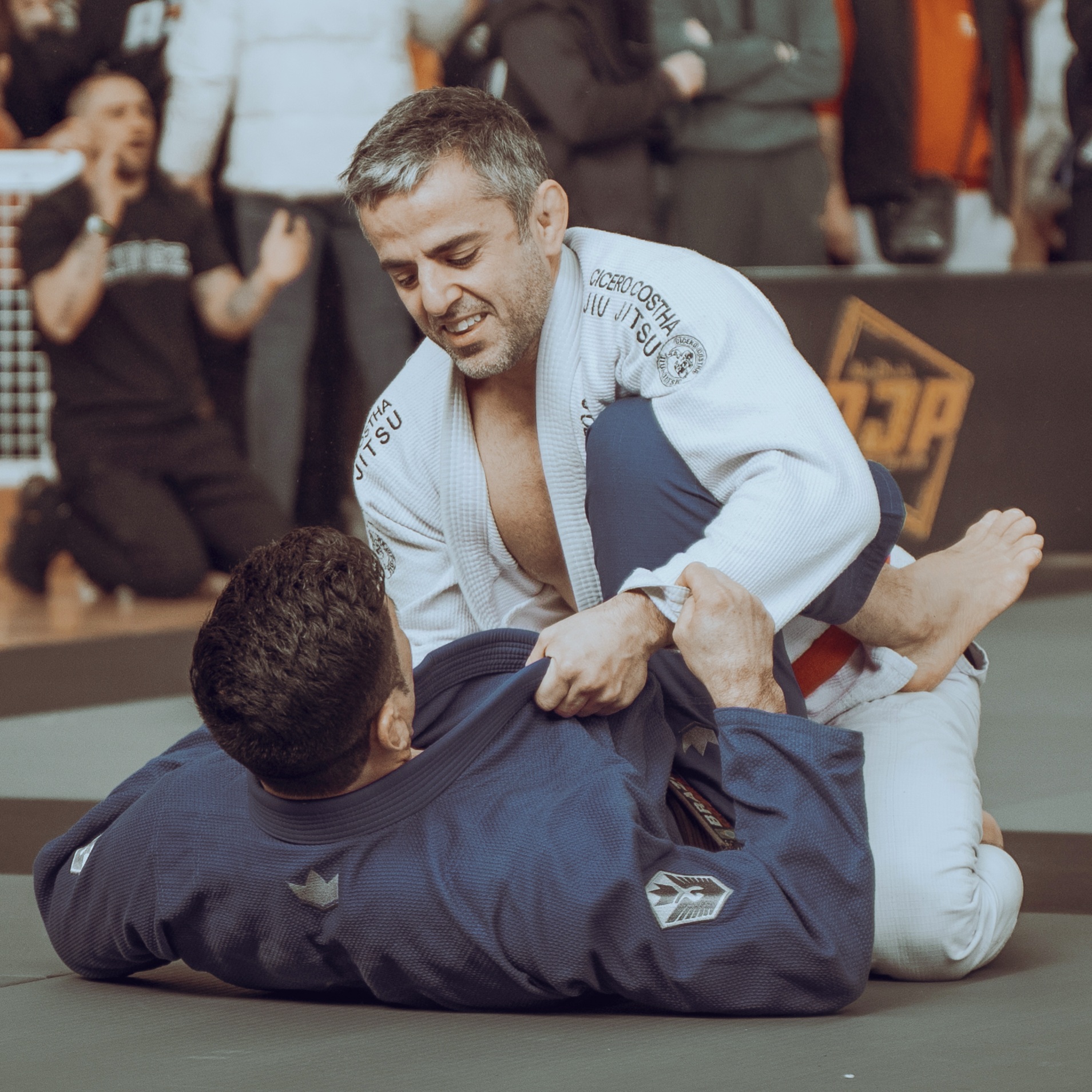
Javier Feliubadaló
4th-degree BJJ black belt under Cícero Costha and head coach at Circle Academy (Gràcia, Barcelona). IBJJF European Champion, IBJJF Pan and World No-Gi medalist, actively competing in Master 5 black belt featherweight.
Meet Javier →Informative Disclaimer
This content is for educational and informational purposes only. It does not constitute individual medical or nutritional advice. If your preparation involves weight management or cutting, consult a qualified sports nutrition professional. If you have or have experienced a complicated relationship with food or weight, consult a healthcare provider.