Pre-Competition Activation in BJJ: What Works and What Is a Myth
Before you start
This article provides science-based sports science insights, not individual medical or athletic prescriptions. It does not replace your coach, strength trainer, physician, or sports nutritionist. Nothing here should be introduced for the first time in competition: test everything thoroughly in training first.
The Problem Isn't Getting Activated. It's When
There are two primary ways to arrive at your first match in the wrong state, and they are polar opposites.
The first: you arrive burned out. You turned on your playlist at 7:00 AM, spent two hours staring at the bracket, and warmed up three separate times because your division was delayed. When you finally step onto the mat, your nervous energy is spent.
The second: you arrive flat. You sat isolated with noise-canceling headphones, stayed completely still, and walk onto the mat cold. Your first minute is lost just waking your nervous system up.
Pre-competition activation is the practice of avoiding both extremes. It is not about ramping up to maximum arousal; it is about hitting the right zone at the right time.
What We Know vs. What Gets Repeated Without Evidence
Let's start by clearing the field, because combat sports culture is full of scientific-sounding claims with minimal empirical backing.
The "Catecholamine Window"
It is often claimed that stress hormones peak functionally 20 to 30 minutes after an initial stimulus, meaning your routine must conclude exactly 25 minutes prior to stepping on the mat.
There is no rigorous evidence supporting that exact number. It sounds tidy and gets repeated, but individual sympathetic responses vary drastically depending on the athlete, the environment, and the stimulus. What works is finding your personal window through repeated simulation in practice.
The Yerkes-Dodson Law
The inverted-U curve—optimal performance at intermediate arousal—dates back to 1908 mice experiments. Its direct application to complex athletic decision-making has been criticized for decades. As a rough metaphor (neither sleepy nor overwhelmed), it remains useful; as an exact physiological law with a quantifiable peak, it is not.
The Nervous System Is Not an On/Off Switch
What truly matters: you are not trying to permanently "turn on" the sympathetic system and "shut off" the parasympathetic. You are training state transition capacity.
In the days leading up to an event, parasympathetic dominance is essential for digestion, recovery, and tissue repair. On tournament day, you need the ability to transition smoothly into controlled sympathetic arousal, and drop back down between bouts.
What the Evidence Actually Supports
1. Specific Dynamic Warm-Up
A 2026 meta-analysis on Post-Activation Performance Enhancement (PAPE) in combat sports demonstrated that dynamic, sport-specific movements consistently outperformed traditional heavy strength protocols. Sport-specific warm-ups proved vastly superior to generic cardiovascular jogging or stationary cycling.
In grappling terms: explosive uchi-komi, level changes, lapel grip snaps, and guard recovery movements prepare the neuromuscular system far better than 20 minutes on an exercise bike.
- Dynamic joint mobility mimicking guard transitions and hip escapes
- Short explosive bursts (5-10 seconds) with full recovery between efforts
- Controlled technical flow drilling with a partner at ascending tempo without producing systemic fatigue
2. Motor Imagery and Visualization
Extensive meta-analyses demonstrate that mental practice generates measurable neuromuscular and cognitive benefits across motor skills. In grappling, visualization should focus on:
- First contact sequences: grip fighting, grip breaks, and initial posture control
- Tactical problem solving: how to react if pulled into 50/50, closed guard, or deep half guard
- Internal perspective: visualizing from your own eyes (first-person) rather than watching yourself like a spectator
3. Controlled Breathwork
Voluntary slow breathing (around 6 breaths per minute) directly stimulates vagal tone, increases heart rate variability (HRV), and reduces pre-competition panic. When adrenaline runs excessively high, prolonging the exhalation phase (e.g., inhale 3s, exhale 6s) stabilizes cardiac rhythm.
The 60-Minute Timeline
| Minutes Out | Action Protocol | Objective |
|---|---|---|
| 60–40 | Sensory isolation, check brackets, gear prepared | Reduce ambient cognitive load |
| 40–30 | Tactical imagery, 2-3 opening sequences | Prime automated decisions |
| 30–15 | Progressive sport-specific warm-up | Tissue temp & neuromuscular readiness |
| 15–8 | Breathing regulation (slow exhales if over-aroused; rapid breaths if flat) | Arousal calibration |
| 8–3 | Short conditioning activity (PAPE priming) | High-threshold motor unit recruitment |
| 3–0 | Brief anchoring routine, gi check, step into bullpen | State entry |
Three Costly Mistakes
Activating too early. The most common error. Hitting peak intensity two hours before your fight means competing during the neurochemical trough. Stage your warm-up incrementally.
Confusing lethargy with calmness. You feel peaceful, but only because your central nervous system is depleted. Tracking resting metrics and HRV in the preceding days helps spot this difference.
Abandoning your routine when the venue gets chaotic. Bullpens are loud, brackets get delayed, and teammates lose matches. Routines exist specifically to stabilize performance on messy days. Carrying an isolation kit (headphones, eye cover, a designated quiet spot) is essential athletic infrastructure.
References
- Terbalyan A, et al. Effect of Post-Activation Performance Enhancement in Combat Sports: A Systematic Review and Meta-Analysis — Part II: Specific Performance Indicators. J Funct Morphol Kinesiol. 2026;11(2):157. doi:10.3390/jfmk11020157
- Simonsmeier BA, Androniea M, Buecker S, Frank C. The effects of imagery interventions in sports: a meta-analysis. Int Rev Sport Exerc Psychol. 2020;14(1):186-207. doi:10.1080/1750984X.2020.1780627
- Toth AJ, McNeill E, Hayes K, Moran AP, Campbell M. Does mental practice still enhance performance? A 24-year follow-up and meta-analytic replication and extension. Psychol Sport Exerc. 2020;48:101672. doi:10.1016/j.psychsport.2020.101672
- Lindsay RS, Larkin P, Kittel A, Spittle M. Mental imagery training programs for developing sport-specific motor skills: a systematic review and meta-analysis. Phys Educ Sport Pedagog. 2023;28(4):444-465. doi:10.1080/17408989.2021.1991297
- The Effects of Imagery Practice on Athletes' Performance: A Multilevel Meta-Analysis with Systematic Review. Behav Sci. 2025;15(5):685. doi:10.3390/bs14050685
- Laborde S, Allen MS, Borges U, et al. Effects of voluntary slow breathing on heart rate and heart rate variability: A systematic review and a meta-analysis. Neurosci Biobehav Rev. 2022;138:104711. doi:10.1016/j.neubiorev.2022.104711
- Lehrer PM, Gevirtz R. Heart rate variability biofeedback: how and why does it work? Front Psychol. 2014;5:756.
- Sevoz-Couche C, Laborde S. Heart rate variability and slow-paced breathing: when coherence meets resonance. Neurosci Biobehav Rev. 2022;135:104576.
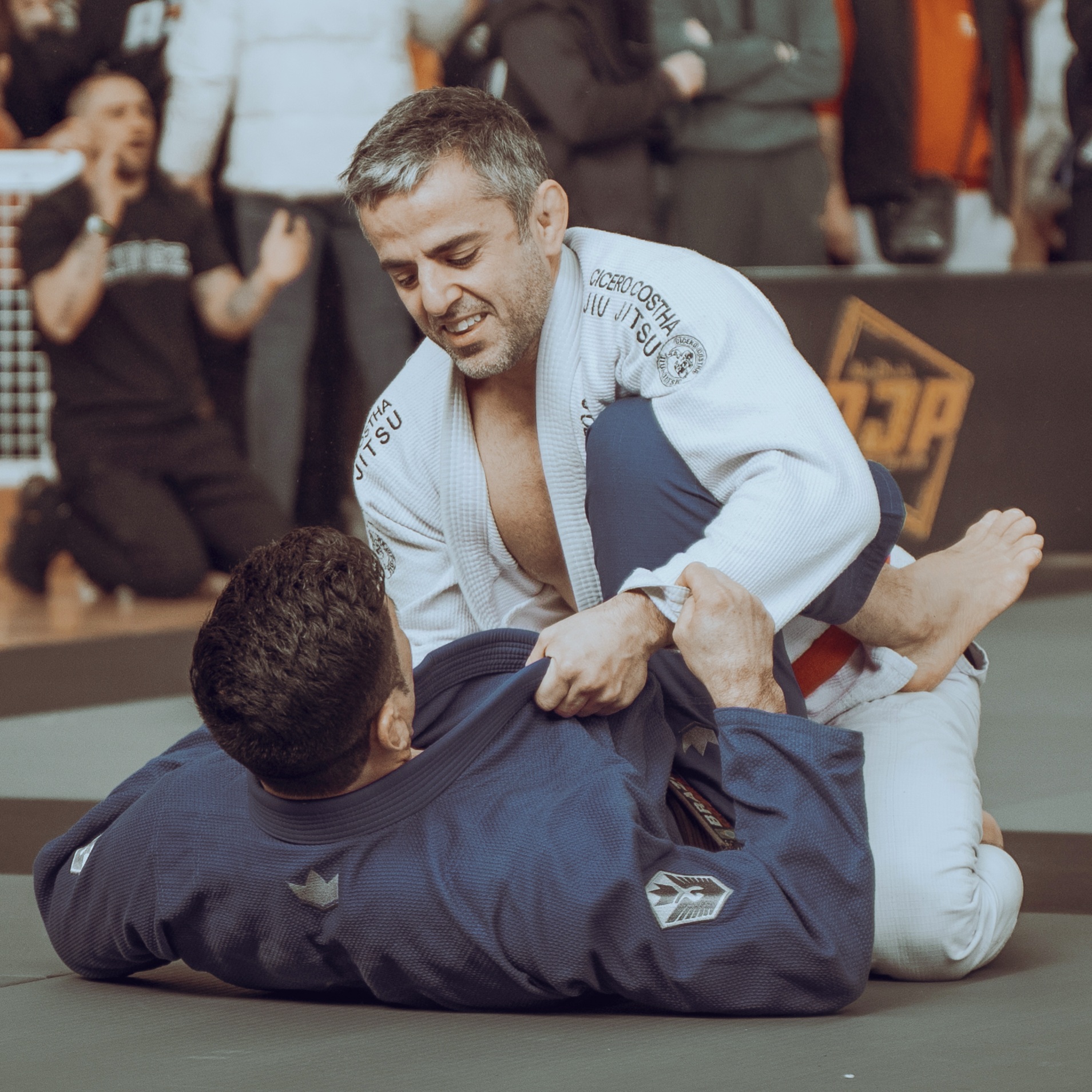
Javier Feliubadaló
4th-degree BJJ black belt under Cícero Costha and head coach at Circle Academy (Gràcia, Barcelona). IBJJF European Champion, IBJJF Pan and World No-Gi medalist, actively competing in Master 5 black belt featherweight.
Meet Javier →Informative Disclaimer
This content is for educational and informational purposes only. It does not constitute individual medical or nutritional advice. If your preparation involves weight management or cutting, consult a qualified sports nutrition professional. If you have or have experienced a complicated relationship with food or weight, consult a healthcare provider.