Pre-Competition Routines in BJJ: Evidence and Practice
Updated:
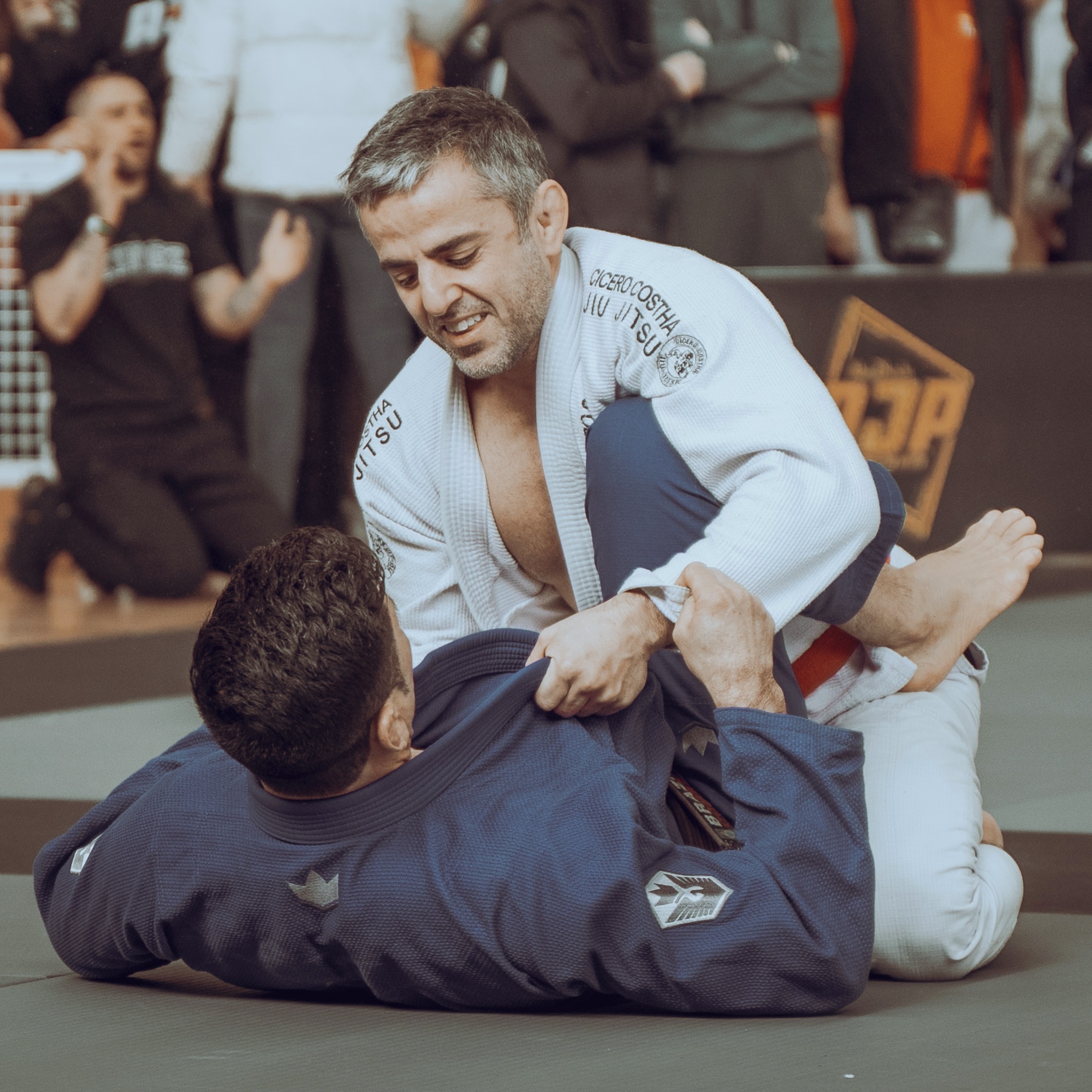
Before you start
This article discusses scientific literature for educational purposes; it is not an individual prescription. It does not replace your coach, strength and conditioning coach, doctor or sports nutritionist. Nothing you read here should be tried for the first time in competition: everything must be tested in training first.
Let us start with what it is not
A version of this subject circulates in high-performance circles that we should address before going any further.
That version says pre-competition rituals are "neural anchors" which, through classical conditioning, activate "complete networks associated with high-performance experiences", so the body "recreates the corresponding chemistry" through "somatic markers".
It sounds like neuroscience. It is not. Much of that vocabulary comes from neuro-linguistic programming, a framework with a weak empirical basis that has spent decades without accumulating serious experimental support. Terms borrowed from real neuroscience—neural networks, somatic markers—are being used as metaphors, not as demonstrated mechanisms.
The interesting thing is that the practice does work. What fails is the explanation.
There is solid literature on pre-performance routines. It simply does not say what anchoring courses say.
What the evidence does say
A pre-performance routine (PPR in the literature) is a set of task-relevant thoughts and actions that an athlete systematically performs before executing a skill.
That definition contains the key phrase: task-relevant. It separates a routine from a superstition. Adjusting your belt, taking three breaths and fixing your gaze is a routine. Putting on your lucky socks is not.
The finding
A meta-analysis published in the International Review of Sport and Exercise Psychology brought together 112 effect sizes across fifteen sports. The results:
- In pre-post designs: a small but significant effect (SMC = 0.31)
- In experimental designs without pressure: a moderate-to-large effect (g = 0.64)
- In experimental designs under pressure: g = 0.70
In other words, the benefit does not disappear as pressure rises. If anything, that is where it is most noticeable. And the authors found benefits in both novices and elite athletes, which is unusual in this literature.
Two findings that contradict what is usually taught
First: individualization is not necessary. The authors explicitly conclude that, from a performance perspective, personalizing the intervention does not appear necessary—standardized routines help just as much.
This directly contradicts the narrative of a "five-stage protocol for installing your personal anchor". You do not need that. You need consistency, which is something else.
Second: what you build it from does not matter. The effect holds both for simple, single-element routines and for extensive, multi-element routines, and across very different elements—visualization, sustained visual focus, left-hand contraction. The practitioner has room to choose.
The honest limitation—and in BJJ it is a big one
Here comes the part almost nobody mentions.
Most tasks studied are closed, self-paced skills: a golf putt, a basketball free throw, a tennis serve, a bowling delivery. These are actions where the athlete decides when to execute them, in a stable environment.
The authors themselves say it: we do not have evidence of whether routines also help with externally paced skills.
BJJ is the opposite of a golf putt. It is an open skill, with an opponent making decisions at the same time as you, in an environment that changes every second. Transfer has not been demonstrated.
Where it reasonably fits: the tournament moments that are self-paced. The wait before stepping out. The walk to the competition area. The seconds before the slap & bump. There you control the timing, and there the free-throw analogy holds up reasonably well.
Where there is no basis for promising anything: in the middle of a scramble. A "crisis anchor" supposedly giving you clarity while someone is closing a choke is an unsupported extrapolation. It may help you; I cannot tell you that science says it does.
The four proposed mechanisms
The literature proposes four ways a routine might work. None requires invoking recreated chemistry or complete neural networks:
Attentional focus. The routine occupies attention with relevant content and leaves less room for noise—the crowd, the opponent, the score, what happened in the previous match.
Arousal regulation. The breathing and rhythm elements do exactly what they claim to do: modulate activation.
Procedural automaticity. It allows the motor pattern to execute with minimal conscious interference. It is the antidote to overthinking, a common way of failing under pressure.
Situational self-efficacy. Completing the routine creates a sense of control and readiness. And pre-event self-efficacy has its own documented relationship with performance.
None of these mechanisms is magical. All are sufficient to explain the observed effect.
Routine or superstition: the test
The distinction is about function, not form. Three practical criteria:
| Routine | Superstition | |
|---|---|---|
| Control | The action depends on you | It depends on something external |
| Connection | To the process | To the outcome |
| Flexibility | It adapts if conditions change | It is rigid; its absence creates anxiety |
The ultimate test: if one day you cannot perform it—your match is brought forward, you lose your bag, there is nowhere to warm up—what happens?
If you reorganize, it was a routine. If you fall apart, it was a superstition, however much it resembled a routine.
This matters because rigidity is a real risk in competition. A BJJ tournament is an exercise in chaos: schedules break down, brackets are reorganized, your match is delayed by two hours or brought forward twenty minutes. A routine that only works under ideal conditions is a liability.
How to build your own
1. Choose the self-paced moments
Do not try to cover the whole match. Cover the points where you control the timing:
- The waiting area, before you are called
- Walking to the competition area
- The seconds before the greeting
- Between matches (see article 3)
2. Combine evidence-backed elements
Three or four are enough. Those with literature behind them:
- A breathing element. Three breaths with a long exhalation, or box breathing
- A visualization element. Only the first movement, not the whole match. Ten seconds
- A physical element. Adjusting the gi, squeezing and releasing a grip, planting your feet firmly
- A short word or phrase. Process-oriented, not outcome-oriented: "pressure", "posture", "grip first"—not "I am going to win"
3. Put it in order and do not change it
Consistency is the active ingredient. Same order, same elements.
4. Keep it short
Sixty to ninety seconds. A five-minute routine will not survive a real tournament.
5. Rehearse under pressure, not only when calm
This is the point most people skip. Practising on good days, relaxed, in an empty changing room does not prepare you to execute it in a packed venue when your match has been brought forward.
Integrate the routine into your hard training rounds and competition simulations. Let your system associate it with real conditions, not comfortable ones.
6. Design the short version
Have a fifteen-second version ready for the day when there is no time. The existence of that variation is what stops the routine becoming a dependency.
Signals with your coach
A practical section, although there is no specific literature to cite here: this is coaching judgment.
Agreeing visual and verbal signals with your corner reduces noise and prevents your coach from having to shout lengthy instructions that you neither hear nor process in the middle of an exchange.
What works is the same as in a routine: a few signals, always the same ones, focused on the process. Three or four clear codes are worth more than an extensive vocabulary nobody remembers under pressure.
Examples of structure, not content—each team should establish and practise its own:
- One signal to slow the pace
- One to attack
- One to correct posture or base
- One for "forget the mistake, next action"
What matters is not which ones you choose. It is that they are agreed beforehand and have been used in training.
What to expect, honestly
The effect is real and modest. It will not turn you into a different competitor. It will help you consistently reach your level rather than perform according to how you feel when you wake up.
And for BJJ specifically, the evidence is borrowed: it comes from self-paced, closed-skill sports. It is a reasonable extrapolation for waiting and transition moments, and an unsupported extrapolation for what happens during the match.
We would rather tell you that than sell you an anchoring system dressed in neuroscience vocabulary.
References
- Rupprecht AGO, Tran US, Gröpel P. The effectiveness of pre-performance routines in sports: a meta-analysis. Int Rev Sport Exerc Psychol. 2024;17(1):39-64. doi:10.1080/1750984X.2021.1944271
- Orbach I, Blumenstein B. Preparatory routines for emotional regulation in performance enhancement. Front Psychol. 2022;13:948512. doi:10.3389/fpsyg.2022.948512
- Lochbaum M, Sisneros C, Cooper S, Terry PC. Pre-Event Self-Efficacy and Sports Performance: A Systematic Review with Meta-Analysis. Sports. 2023;11(11):222. doi:10.3390/sports11110222
- Simonsmeier BA, Andronie M, Buecker S, Frank C. The effects of imagery interventions in sports: a meta-analysis. Int Rev Sport Exerc Psychol. 2020;14(1):186-207. doi:10.1080/1750984X.2020.1780627
- Hazell J, Cotterill ST, Hill DM. An exploration of pre-performance routines, self-efficacy, anxiety and performance in semi-professional soccer. Eur J Sport Sci. 2014;14(6):603-610. doi:10.1080/17461391.2014.888484
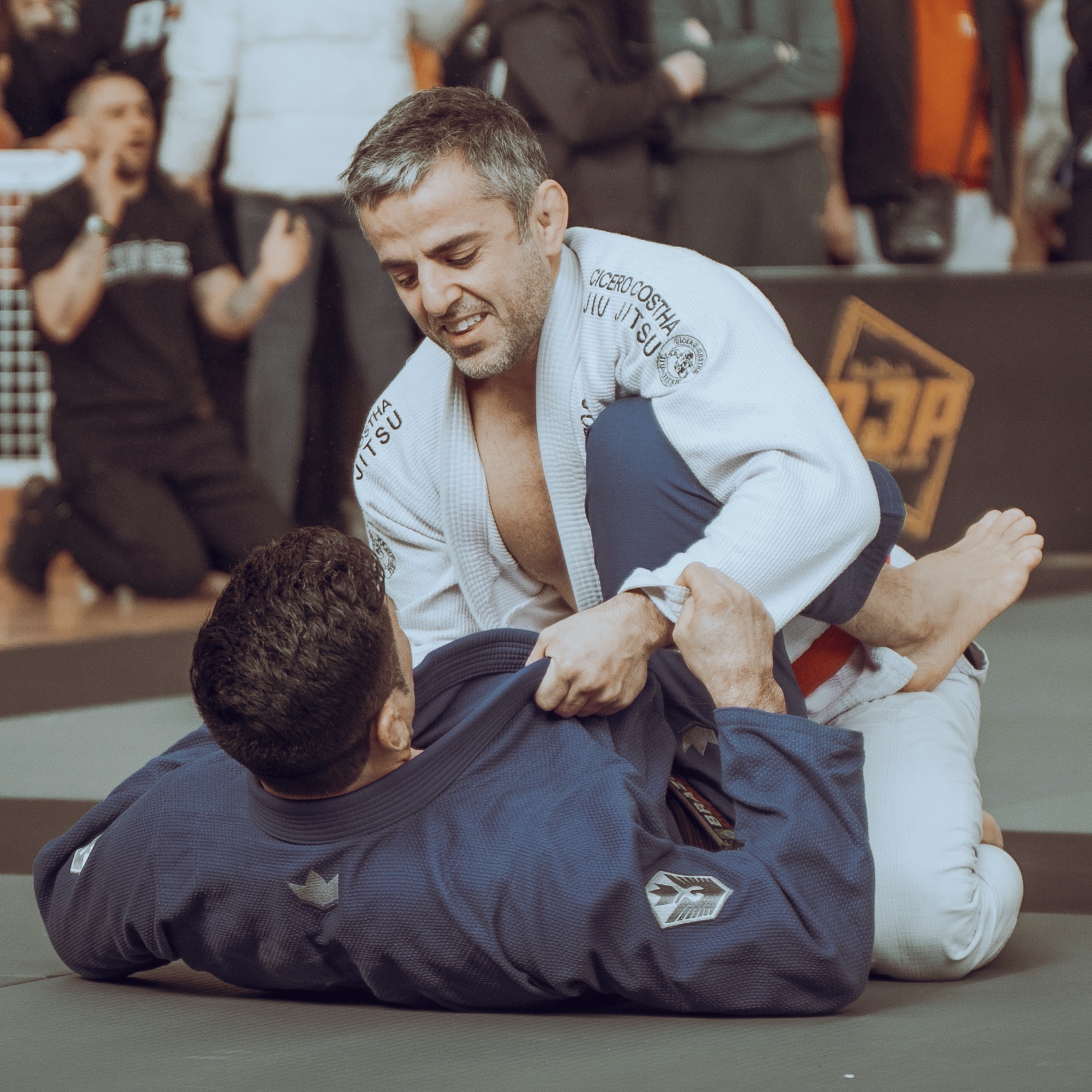
Javier Feliubadaló
4th-degree BJJ black belt under Cícero Costha and founder of Circle Academy (Gràcia, Barcelona). IBJJF European Champion, IBJJF Pan and World No-Gi medalist, actively competing in Master 5 black belt featherweight.
Meet Javier →Informative Disclaimer
This content is for educational and informational purposes only. It does not constitute individual medical or nutritional advice. If your preparation involves weight management or cutting, consult a qualified sports nutrition professional. If you have or have experienced a complicated relationship with food or weight, consult a healthcare provider.